An Elderly fall detection smart restroom IoT system combines connected sensors, emergency communication, and age-friendly restroom design. It helps identify dangerous events when an older adult slips, collapses, or remains motionless.
Dr. Joseph Coughlin, founder and director of the MIT AgeLab, has said, “Aging is not a disease to be cured, but a process to be experienced.” This perspective matters. The system should support dignity, independence, and practical daily living. It should not turn a private restroom into a clinical surveillance space.
Non-camera sensors can monitor movement, floor pressure, humidity, door activity, and unusual inactivity. A wearable device may add heart-rate or location data. When several signals suggest a fall, the platform can send an alert to caregivers or an approved response center. Clear escalation rules are essential. False alarms can cause stress. Missed events can be far more serious.
A reliable Elderly fall detection smart restroom IoT solution needs careful installation and regular testing. Grab bars, non-slip flooring, bright lighting, and reachable emergency buttons remain important. Technology cannot replace safe physical design. That is an uncomfortable limitation.
Privacy also requires attention. Data should be minimized, encrypted, and accessed only by authorized people. Consent should be understandable for older users and their families. Some homes may have weak internet connections. Batteries may fail. Sensors may misread ordinary activities.
This article explains how the system works, where it helps, and where its promises need honest examination. Safety improves through thoughtful design, not impressive devices alone.
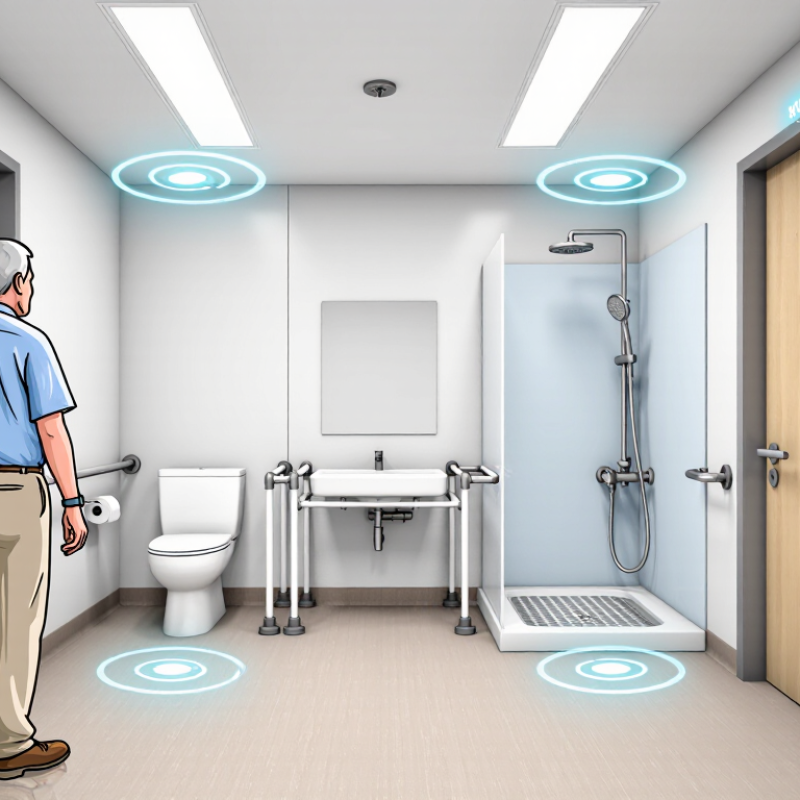
An elderly fall detection smart restroom IoT system is a connected safety setup for bathrooms used by older adults. It combines motion sensors, floor pressure sensing, door status data, and optional wearable signals. The system studies patterns linked to a collapse, such as sudden impact followed by unusual stillness. It is not simply a camera. Many designs avoid video to protect dignity.
Its main purpose is to identify possible falls quickly and alert a caregiver, nurse station, or emergency contact. An alert may show the restroom location, detection time, and continuing movement status. Some systems process signals through a local gateway before sending limited data through a secure network. This can reduce delays and limit unnecessary exposure of personal information. In practice, sensors must handle steam, splashes, glare, and dim nighttime lighting. Installation quality matters.
From a care perspective, the system supports human judgment rather than replacing it. It creates a faster route to someone who may be injured, confused, or unable to reach a pull cord. Care teams should test alerts during walking, sitting, assisted transfers, and harmless slips. False alarms happen. A dropped towel may trigger a warning, while a slow slide may go unnoticed. Regular testing, accessible reset controls, and clear response procedures improve reliability. No design is perfect. Teams should also review data storage, access permissions, and retention periods, because these details are often overlooked.
A smart restroom combines several sensors to identify falls, unusual inactivity, and hazardous conditions. The need is substantial. The World Health Organization reports about 684,000 fatal falls globally each year, with adults over 60 facing the greatest risk. The U.S. Centers for Disease Control and Prevention also reports that more than 3 million older adults receive emergency treatment for fall injuries annually.
Pressure sensors beneath the floor can detect a sudden impact and a person remaining still. mmWave radar can monitor movement without cameras, protecting privacy during bathing or toileting. Door contacts, passive infrared sensors, and toilet-area occupancy sensors provide useful timing information. Temperature, humidity, water-leak, and air-quality sensors add environmental context. A wet floor is not a minor detail.
An edge gateway processes urgent signals locally, then sends verified alerts through secure Wi-Fi, cellular, or wired networks. Care staff may receive the room location, event time, and sensor pattern instead of vague alarm messages. However, false alarms remain possible. A dropped towel can resemble a fall. Privacy settings, backup power, routine testing, and human confirmation are essential. No sensor is perfectly wise.
What Is an Elderly Fall Detection Smart Restroom IoT System?
How the System Detects Falls and Assesses Emergency Conditions
An elderly fall detection smart restroom IoT system combines motion, pressure, and environmental sensors. It watches movement without requiring the user to wear a device. A ceiling sensor can track posture changes and sudden downward motion. Floor sensors may detect unusual pressure near the toilet or shower. Door sensors can show whether someone entered but did not leave.
The system compares these signals over several seconds. A rapid height drop, followed by stillness, may indicate a fall. It can also examine body position, movement recovery, and the time spent on the floor. Microphones are sometimes used for voice requests, but privacy protection must remain central. The system should process limited information and avoid unnecessary recording.
Emergency assessment needs more than one signal. If the person remains still, calls for help, or misses a normal exit pattern, the system can send an alert to trained staff or family members. A speaker may ask, “Are you safe?” A response can reduce unnecessary escalation. No alert is perfect. A dropped towel can imitate a small event, while a quiet person may need help without making a sound. False alarms require review, not blame. Regular testing with different lighting, wet floors, walking speeds, and mobility aids improves reliability. Human confirmation still matters, especially when the data appears incomplete.
An elderly fall detection smart restroom IoT system combines motion sensors, floor pressure sensing, and a discreet wall alert. It watches for sudden impact, prolonged stillness, or an unanswered assistance request. The need is substantial. The World Health Organization’s Falls fact sheet reports about 684,000 fatal falls annually, with adults over 60 facing the greatest risk. The U.S. Centers for Disease Control and Prevention estimates that one in four older adults falls each year. A restroom, often private and wet, deserves specific attention.
Alert delivery must use several channels, rather than one phone. A local speaker can request a spoken response. Simultaneously, the system can send a time-stamped notification to a caregiver dashboard and approved mobile device. If no acknowledgement arrives within two minutes, escalation can reach a second responder or emergency coordination center. The caregiver sees room location, sensor status, and last movement, without an intrusive video feed. This supports dignity and faster decisions. Yet two minutes may be too long after a head injury.
Caregiver response should follow a clear script: call the resident, check consciousness, avoid lifting, and contact emergency services when danger signs appear. The CDC’s STEADI materials emphasize medication review, gait assessment, and environmental safety. Detection is only one prevention measure. In practice, false alarms, weak Wi-Fi, low batteries, and wet surfaces can reduce trust. Monthly test drills expose these gaps. I would also record acknowledgement times and missed alerts. Data may look reassuring while a resident remains alone. Human judgment still matters, and the system should admit uncertainty.
A smart restroom IoT system uses motion sensors, floor-pressure sensing, inactivity detection, and automated alerts to identify a possible fall. The system can notify a caregiver, support two-way communication, and coordinate emergency assistance when the user does not respond.
The chart provides rounded annual U.S. estimates reported by the U.S. Centers for Disease Control and Prevention: more than 3 million older adults are treated in emergency departments for fall-related injuries, approximately 800,000 are hospitalized, and about 32,000 die from falls each year.
What Is an Elderly Fall Detection Smart Restroom IoT System?
An elderly fall detection smart restroom IoT system combines motion sensors, floor pressure sensing, and emergency alerts. It watches for unusual inactivity, sudden impact, or prolonged time near the floor. Unlike a camera, a privacy-focused system can work without recording images. Data should remain local whenever possible, with clear consent from the user and family. A qualified installer should test detection near the toilet, shower, and doorway. Bathroom conditions are difficult. Steam, towels, and poor lighting may create false alarms. No system is perfect.
Safety depends on careful response planning. An alert should reach a trained caregiver, not only a mobile application. Staff need a simple procedure for checking the restroom, speaking calmly, and documenting the event. Non-slip flooring, grab rails, warm lighting, and outward-opening doors still matter. Technology cannot replace basic fall prevention. Maintenance also requires discipline. Inspect sensors monthly, replace batteries early, clean pressure surfaces, and test emergency buttons after repairs. A maintenance log improves accountability, although busy facilities may not update it consistently.
Tips: Ask users before collecting any data. Explain what the sensors detect. Post a visible emergency instruction card. Review false alarms every month. Future systems may learn personal movement patterns, detect dehydration risks, or connect with wearable devices. These features could improve care, but they also increase privacy concerns. Developers should use encrypted data, limited access, and independent safety testing. Elderly users deserve systems that are helpful without feeling watched.
| Dimension | Data Metric or Design Factor | Reference Data or Recommended Value | Practical Application in a Smart Restroom | Evidence Status |
|---|---|---|---|---|
| Need and Risk | Annual fall prevalence among older adults | Approximately 1 in 4 adults aged 65 years and older falls each year, although reporting and definitions vary by population and study. | Justifies continuous, non-intrusive monitoring in bathrooms, where wet floors, transfers, and limited space can increase risk. | Public-health evidence |
| Need and Risk | Fall-related mortality | Falls are a major cause of unintentional injury death among older adults worldwide; the World Health Organization reports more than 684,000 fatal falls globally each year across all age groups. | Supports rapid escalation when a suspected fall is followed by immobility or an absent response. | Public-health evidence |
| Detection | Detection inputs | Recommended combination: privacy-preserving presence sensing, door status, floor moisture, toilet or grab-bar load sensing, and an emergency call button. | Multiple inputs can reduce reliance on a single sensor and help distinguish a fall from normal bathing, sitting, or standing activity. | Design recommendation |
| Detection | Camera use | Use non-camera sensing wherever possible. If imaging is necessary, processing should occur locally, with no routine storage of identifiable video. | Protects dignity in a highly private environment while retaining the ability to detect prolonged inactivity or an unusual posture. | Privacy-by-design |
| Detection | Alert confirmation window | A practical design target is a 15–30 second voice or button-confirmation period before escalation, adjustable to the resident’s needs. | Allows a person who dropped an object or deliberately sat on the floor to cancel a false alarm without delaying urgent assistance excessively. | Configurable target |
| Safety Response | Alert escalation sequence | Recommended sequence: local audio prompt, resident confirmation, caregiver notification, secondary contact, and emergency services according to the care plan. | Creates a documented response path instead of sending an isolated notification that may be missed. | Operational model |
| Safety Response | Recommended response target | Set a locally agreed target, such as caregiver acknowledgement within 1 minute and physical welfare checking within 5 minutes for a high-confidence event. | Targets must be documented, tested, and adapted to staffing, building layout, and the resident’s medical risk. | Care-plan target |
| Safety Response | Manual cancellation and accessibility | Provide large, high-contrast controls, audible prompts, visual indicators, and at least one reachable emergency control from floor level. | Supports users with reduced vision, hearing, balance, strength, or cognitive ability. | Accessibility recommendation |
| Privacy | Data minimization | Collect only data required for safety: sensor event, time, location, device status, alert status, and response record. | Avoid continuous audio, identifiable images, unnecessary health details, and unrelated behavioral profiling. | Privacy principle |
| Privacy | Data retention | Use the shortest retention period that supports care review and incident investigation; a common design range is 30–90 days for event logs, subject to local policy. | Automatically delete or anonymize older records and document exceptions for active investigations. | Policy-dependent target |
| Privacy | Access control | Apply unique user accounts, role-based permissions, multi-factor authentication for administrators, and an audit trail for access to records. | Caregivers may view alerts, while technical staff may manage devices without automatically viewing personal care data. | Security control |
| Privacy | Breach notification planning | Where the EU General Data Protection Regulation applies, certain personal-data breaches must be reported to the supervisory authority within 72 hours after awareness, unless an exception applies. | Maintain an incident-response process covering detection, containment, assessment, notification, and documentation. | Jurisdiction-specific rule |
| Cybersecurity | Data protection in transit and storage | Use modern encrypted transport, encrypted storage, secure key management, signed firmware, and disabled default credentials. | Reduces the risk that sensor events, occupancy information, or emergency contacts can be intercepted or altered. | Security baseline |
| Reliability | Power and network resilience | Provide battery backup or emergency power for critical components and maintain a local alert path if internet connectivity fails. | The system should still produce an on-site warning and record the event during a network outage. | Resilience recommendation |
| Maintenance | Routine inspection frequency | Inspect visible sensors, call buttons, cables, mounting points, and warning indicators at least monthly; test the complete alert chain according to the care facility’s risk assessment. | Bathrooms are exposed to humidity, cleaning chemicals, impact, and water deposits, which can degrade performance. | Maintenance recommendation |
| Maintenance | Battery and sensor health | Monitor battery level, sensor heartbeat, calibration status, communication quality, and last successful self-test. | Generate a maintenance ticket before a low battery or failed sensor becomes a safety incident. | Operational requirement |
| Performance | False-alarm management | Track false alarms per room and per month, cancellation time, missed events, and cause category; do not optimize only for fewer alerts. | High false-alarm rates can cause alert fatigue, while excessive filtering may delay assistance during a real fall. | Monitoring framework |
| Human Factors | Consent and resident involvement | Explain the purpose, sensors used, data collected, retention period, alert recipients, and opt-out or alternative-support process where applicable. | Involve the resident, family, caregivers, and clinical or safeguarding staff before deployment. | Governance requirement |
| Integration | Interoperability | Use documented interfaces and exportable event records so alerts can connect with nurse-call, building-management, and electronic care systems without locking data into one platform. | Improves continuity of care and makes replacement or expansion easier. | Future-ready architecture |
| Future Development | Edge artificial intelligence | Process posture, motion, and inactivity patterns locally where feasible; transmit event metadata rather than raw personal data. | Can reduce latency and privacy exposure, but models require validation across different mobility aids, body shapes, lighting conditions, and bathroom layouts. | Emerging direction |
| Future Development | Model governance | Before deployment, measure sensitivity, specificity, false-alarm rate, missed-event rate, and performance differences across relevant user groups. | Maintain version records, conduct change reviews, and provide a safe fallback when the model is uncertain. | Responsible-AI control |
| Evaluation | Key outcome indicators | Recommended dashboard: confirmed falls, response time, missed alerts, false alarms, system uptime, unresolved maintenance faults, battery failures, and privacy incidents. | Evaluates whether the system improves safety without creating unacceptable privacy, workload, or reliability problems. | Evaluation framework |
It monitors sudden impacts, prolonged stillness, movement, room occupancy, and assistance requests. It also checks wet floors, leaks, temperature, humidity, and air quality.
Floor pressure sensors can notice impact and continued weight in one position. mmWave radar tracks movement without cameras. Door, motion, and toilet-area sensors add timing details.
It can operate without cameras. Radar and pressure sensing provide movement information while supporting personal privacy. Privacy still needs careful settings.
The system can use a local speaker, caregiver dashboard, and approved mobile device. Each alert should include the room, event time, and sensor pattern. One channel is not enough.
The system can escalate the alert after a selected period, such as two minutes. A second responder or emergency coordination center may then be contacted. Two minutes could still be too slow after a serious head injury.
Call the resident and ask whether they can respond. Check consciousness and visible danger signs. Do not lift the person alone. Contact emergency services when serious injury is suspected.
Yes. A dropped towel, shifting furniture, or wet flooring may confuse the sensors. Human confirmation remains necessary. No sensor is perfectly wise.
Test sensors, alert routes, batteries, backup power, and network connections regularly. Monthly drills can reveal weak Wi-Fi or missed notifications. Small faults matter.
Use local processing when possible, limit collected data, and avoid intrusive video. Record acknowledgement times and missed alerts. The data may look reassuring, but a resident could still be alone.
An Elderly fall detection smart restroom IoT system is an integrated safety solution designed to protect older adults during restroom use, where falls and delayed assistance can create serious risks. It combines motion, pressure, infrared, environmental, and wearable sensors with connected communication technologies to monitor activity without requiring constant supervision. By analyzing movement patterns, unusual inactivity, impact signals, and changes in posture, the system can identify a possible fall and assess whether the situation may require immediate attention.
When an emergency is detected, alerts can be sent to designated caregivers or support staff through connected devices, enabling a faster and more coordinated response. Privacy should be protected through minimal data collection, secure communication, and careful sensor placement that avoids unnecessary visual monitoring. Regular testing, battery replacement, software updates, and equipment inspections are essential for reliable operation. Future development may improve detection accuracy, personalized risk assessment, voice assistance, and integration with broader health and home-care services while maintaining safety, dignity, and user independence.