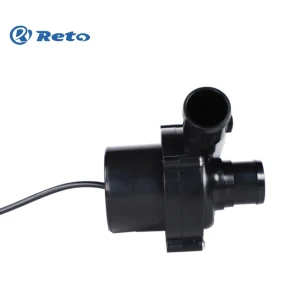
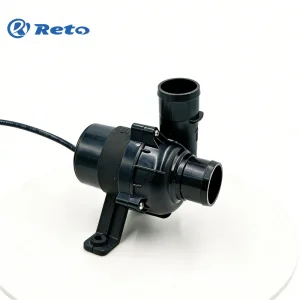
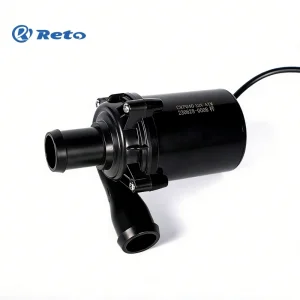
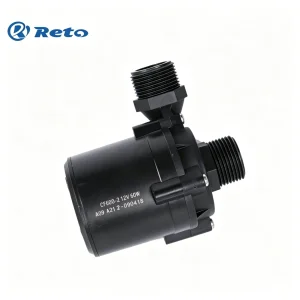
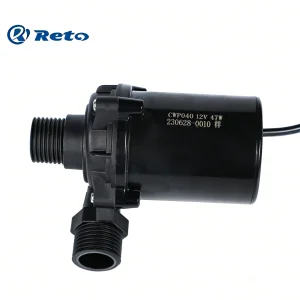
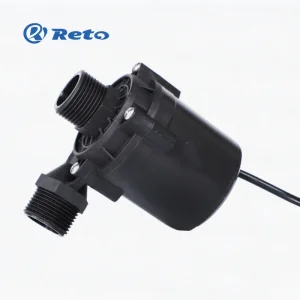
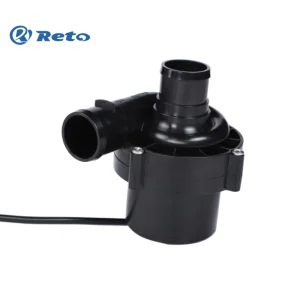
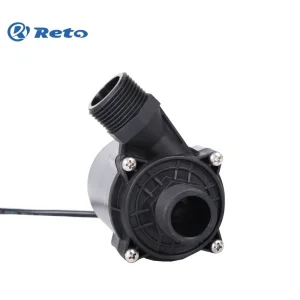
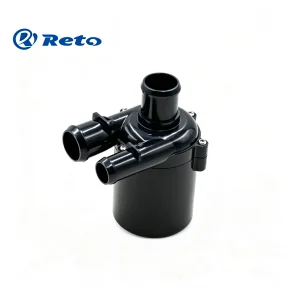
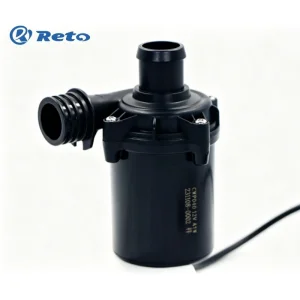
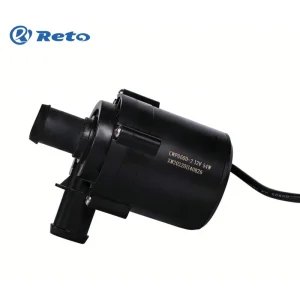
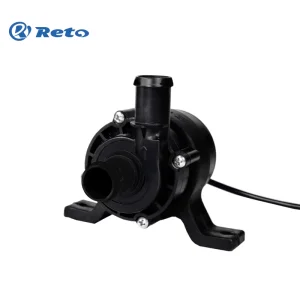
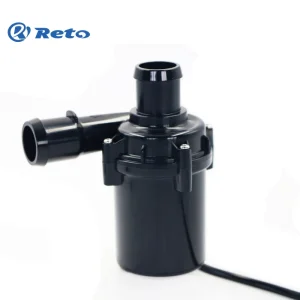
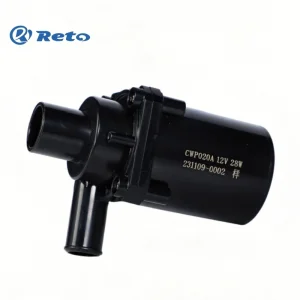
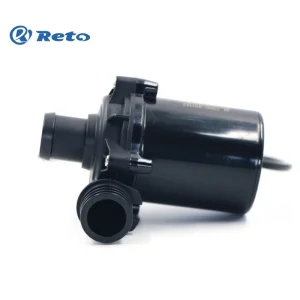
Standardized, variable-frequency booster systems specifically configured for smart bidet seats and integrated tankless ceramic fixtures.
A rigorous examination of fluid dynamics, acoustic decoupling, and efficiency metrics in premium sanitary ware applications.
Traditional shaded-pole or permanent-split capacitor AC pumps operate at fixed rotational velocities, causing intense hydrodynamic cavitation during partial-load demand. Modern BLDC architectures leverage 32-bit DSP controllers executing sinusoidal Field-Oriented Control (FOC) to achieve smooth torque delivery, virtually eliminating commutation ripple and acoustic emissions.
By discarding dynamic mechanical shaft seals in favor of static O-ring containment shrouds made of PPS/PPE engineering thermoplastics, external leakage risks are permanently engineered out. High-coercivity Neodymium-Iron-Boron (NdFeB) rotors drive high-efficiency closed impellers across a non-magnetic separation can.
Urban high-density residential architecture demands whisper-quiet sanitary mechanisms. Brushless direct-drive impellers dynamically balanced to ISO 1940 G2.5 standards minimize high-frequency vibration transmission through the ceramic body, consistently measuring under 38 dB(A) at a 1-meter listening perimeter.
How concentrated supply chain clusters in Fujian, Zhejiang, and Guangdong compress engineering cycle times and provide robust cost-performance ratios.
Chinese pump facilities integrate high-precision CNC injection mold fabrication, stator winding, SMT PCB surface mounting, and automated end-of-line testing within a tight 50-kilometer industrial radius. This co-location cuts OEM prototype turnaround from industry averages of 16 weeks down to under 21 calendar days.
By transplanting IATF 16949 automotive manufacturing standards into commercial sanitary pump production, factories deploy optical AOI inspection, automated stator potting under vacuum, and 100% helium mass-spectrometer leak verification, keeping field failures well below 50 PPM.
China's rare-earth processing capabilities directly anchor the supply chain for sintered NdFeB magnets. Combined with in-house silicone elastomer molding and dedicated ceramic shaft grinding (Zirconia ZrO2 / Silicon Carbide SiC), suppliers provide cost-performance ratios that cannot be matched in segmented assembly environments.
Key architectural variables evaluated during tier-1 brand selection audits.
| Performance / Material Spec | Conventional AC Booster Pump | Commercial 12V DC Brushless Pump | Heavy-Duty 24V FOC Smart Toilet System |
|---|---|---|---|
| Operating Efficiency | 22% – 35% (High thermal losses) | 65% – 75% (Low heat dissipation) | 82% – 88% (Ultra-high energy efficiency) |
| Acoustic Rating (at 1m) | 52 – 62 dB(A) (Humming & resonant) | 42 – 48 dB(A) | ≤ 35 – 38 dB(A) (Whisper-quiet tier) |
| Input Modulation | Constant On/Off only | 0-5V Analog or PWM Duty Cycle | CAN-bus / LIN / UART / Closed-loop PWM |
| Shaft / Bushing Pairing | Stainless Steel AISI 304 / Bronze | Alumina Ceramic (Al2O3) / Carbon | Precision Zirconia (ZrO2) / High-Density Graphite |
| Dry-Run Thermal Defense | Thermal fuse trip (Destructive) | Over-temperature circuit cutoff | Algorithm-driven sensorless stall & dry-run cutoff |
| Expected Operating Life | 3,000 – 5,000 Operating Cycles | 15,000 – 20,000 Hours | > 50,000 Hours Continuous MTBF |
Navigating global plumbing, potable water contact, electrical safety, and electromagnetic interference certifications.
Wetted materials comply with NSF/ANSI 61, WRAS, and ACS mandates. Impellers, housings, and sealing compounds eliminate heavy metal leaching, phthalates, and bisphenol release under continuous hot-water rinse cycles up to 85°C.
Low-voltage direct-current control systems feature on-board LC filtering to meet EN 55014-1/2, FCC Part 15 Class B, and CE directives, ensuring zero electrical interference with seat heating elements, radar presence sensors, or nearby home Wi-Fi gear.
North American (cUPC/ASME A112.19.2) and European (EN 1717) plumbing codes mandate strict backflow prevention. Our pump geometries support high-pressure head delivery that pairs with upstream atmospheric air breaks (Class AA/AB) to eliminate contamination risks.
The interior sanitary cavity is prone to condensation and occasional water leaks. Complete vacuum epoxy filling ensures all printed circuit boards and magnet wires achieve IP68 hermetic sealing, resisting moisture ingress across years of humid bathroom exposure.
From zero-water-pressure high-rise residential retrofits to smart home IoT ecosystem integrations.
Modern skyscrapers and high-density apartments frequently suffer from municipal dynamic pressure drops down to 0.05 MPa during peak morning hours. Integrated brushless booster pumps dynamically ramp up to compensate for line starvation, delivering the requisite 20 L/min siphon force regardless of household supply stability.
Next-generation smart toilets employ dual independent BLDC pumps: a high-pressure, lower-volume unit dedicated to immediate bowl rim surface cleansing, paired with a high-flow centrifugal unit to drive the main bottom trapway siphon jet, optimizing flush water consumption to under 3.8 liters per cycle.
Real-time power monitoring within the BLDC driver reports running current and phase timing back to the toilet's primary logic board. Subtle deviations in current draw indicate impending mineral scale calcification or valve blockage, allowing the system to trigger an automated self-cleaning cycle before an operational failure occurs.
In-depth responses for design engineers, global procurement managers, and quality directors.
Under rated operating conditions (continuous ambient temp < 40°C, clean fluid media, 12V or 24V supply), our automotive-grade BLDC pumps achieve an L10 MTBF of > 50,000 hours, equivalent to over 500,000 intermittent flush cycles, far exceeding typical 10-year household design lifespans.
We deploy high-purity Zirconia ceramic shafts paired with self-lubricating graphite composite bushings. The friction coefficient remains steady (< 0.12), and the non-polar, smooth surfaces resist the deposition of calcium carbonate (CaCO3) and magnesium hydroxide (Mg(OH)2) scale.
Yes. Customization is supported via internal impeller redesigns, volute trim adjustments, and software motor drive tuning. We adapt voltage inputs (12V, 24V, 48V DC) and control logic (PWM, 0-5V, Frequency, Modbus) to match your master controller requirements within 3 to 4 business weeks.
Each unit undergoes 100% automated testing: helium leakage check at 1.2 MPa, electrical insulation breakdown testing at 1500V, dynamic current/wattage profiling, shut-off head and open-flow verification, and acoustic noise testing inside an on-line anechoic box.
Broad-application booster, submersible, and circulating pump units engineered for bidet nozzles, instantaneous heaters, and hybrid sanitary appliances.